

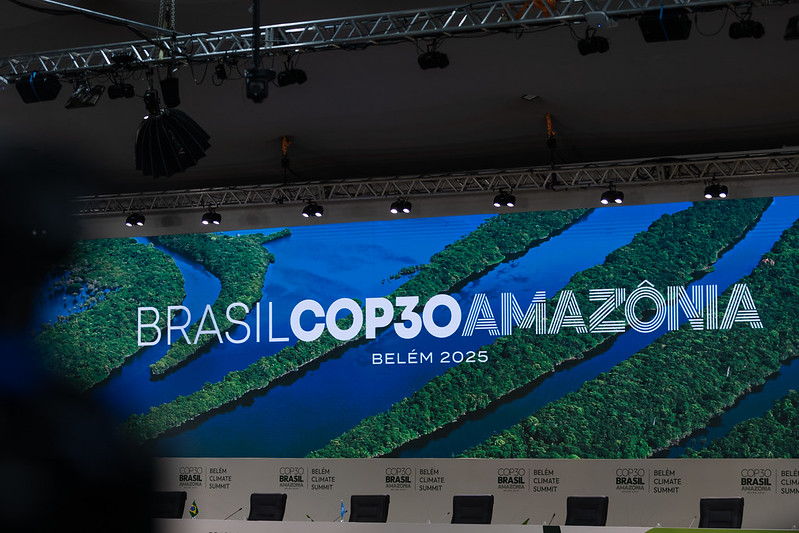
Dispatches from Brazil: What's at Stake in Belém
Amidst protracted conflicts across the world, blatant political and military intervention from foreign powers, and some countries’ withdrawal from crucial international organisations, we live in times of wariness about the effectiveness - and even existence, for some - of international law and multilateralism. The discredit is not by chance: the recent emptiness, both in political stature and attendance, of the EU-CELAC meeting held a few days before COP 30 attests to that. To counter this skepticism, this year’s UN Climate Change Conference, COP 30, has been called the ‘COP of implementation’ by the Brazilian presidency. As such, expectations are high: in times of geopolitical uncertainty and seismic changes in the international order, would one be gullible to believe that bold plans will finally be put into practice?
Taking place in Belém, in the heart of Brazil’s Amazon rainforest, the gathering marks the end of a cycle of Brazilian presidencies for important multilateral forums: the Amazon Summit (2023), the G20 (2024), and the BRICS+ Summits (2025) all took place in South America’s largest nation, showcasing the country’s longstanding commitment to being a regional and global leader.
The Brazilian presidencies have been distinctive in that they have placed the fight against inequalities and the climate agenda at the centre of all these forums, including the G20 Summit, which traditionally focuses on economic and trade aspects rather environmental concerns. In an astute move, Brazilian diplomacy has swept those into the talks for the environment is simultaneously the source of crucial supplies for the economy and the very stage where all human interactions take place. Mitigating the harmful impacts of human activities over the environment is, therefore, a topic that cannot be brushed off in multilateral talks, and Brazil’s effort to mainstream climate is one to serve as a model.
Brazil has been a prominent player in climate talks since at least 1992, when it hosted the landmark Earth Summit, which led to the creation of the main UN convention on Climate Change, the UNFCCC. Upon this framework convention, important instruments have been built, most notably the Kyoto Protocol (1997) - which held industrialised nations accountable through legally binding emission reduction targets -, and the Paris Agreement (2015) - a multilateral accord aimed at preventing a rise of over 2 degrees Celsius in global temperature compared to pre-industrial levels.
This year, almost 200 countries, civil society organisations, and private sector representatives will gather in Belém to discuss how to effectively implement the Paris Agreement. Brazil’s presidency has its own goals: defending multilateralism, accelerating climate action, and connecting political decisions to people’s everyday lives. Now in his third term as president, Lula da Silva (Workers’ Party) has for decades advocated for Brazil’s admission as a permanent member of the UN Security Council. Likewise, he has been an eloquent voice for the democratisation and reform of the financial architecture, proposing new quotas in the IMF and World Bank to favour developing countries and relieve them from their debt burden. In line with his advocacy for more democratic governance in security and trade is his insistence on democratising climate governance, following well-defined, predictable rules that states will abide by, for those are the derived from multilateral spaces. Or so the plan goes.
Brazil has placed at the forefront of its presidency the integration of the three UN Conventions addressing the crises of climate, biodiversity, and desertification. According to Brazilian experts, integrating the conventions is fundamental for protecting coastal and marine areas and traditional communities, while taking into account each country’s realities and prioritising nature-based solutions. Because the effects of these crises are felt differently across constituencies—affecting vulnerable communities the most, particularly women and girls—the Gender Action Plan, an initiative to mainstream gender equality across all climate-related agreements, must gain greater definition.
The first week of negotiations was marked by baby steps towards a final agreement on more controversial topics such as climate financing and nationally determined contributions. Funding-wise, Brazil is leading efforts to raise as much of the US$1.3 trillion agreed on in the Baku to Belém Declaration as possible. The country has also launched the innovative Tropical Forests Forever Fund, a financial mechanism to generate revenue for tropical forest preservation. Unlike loans and grants, this fund consists of a fixed-incomed financial application whose profits are used to compensate countries that keep their forests standing, so that conservation becomes economically advantageous.
In relation to energy transition, Brazil has been dubious. Rhetorically, the country proposed the Belém Commitment for Sustainable Fuel, or Belém 4X, which aims to increase by four times the global use of biofuels by 2035. Although commendable, especially since placing all bets on electrification might be unrealistic given the persistence of carbon-intensive sectors, this initiative was put forward amid controversy, as Brazil recently authorised the exploration of oil in the equatorial margins of Brazil. How states will harness the potential of their own natural resources to boost the biofuel industry (the sargassum industry in the Caribbean being a powerful example), what technologies are available for countries and what the current picture looks like regarding biofuel production and use are some of the subjects to watch on this regard.
Friction persists on the issue of adaptation. The goal of reaching up to a hundred indicators to monitor climate adaptation worldwide (the GGA, Global Goal for Adaptation) was frustrated due to developing countries’ misgivings that a poor performance might jeopardise future investments in them.
After all, the U.S. absence from the Conference, overall, did more good than harm. Discussions proceeded without Donald Trump’s boycotts and after all American Democrats who joined the discussion are receiving praise for still supporting these spaces. His strong supporter, the Argentinian president Javier Milei, also declined the invitation to attend COP 30. He did not take his country out of the Paris Agreement, though. Not due to lack of willingness - but because the toll would be high to pay, given that the EU-Mercosur agreement is on the brink of being finalised and the EU holds high environmental standards for closing the deal.
References
Association for Women’s Rights in Development (AWID). (2025, November). COP30 key messages [PDF report]. Retrieved November 12, 2025, from https://www.awid.org/sites/default/files/2025-11/awid_cop30-key-messages_en.pdf
Centro Brasileiro de Relações Internacionais (CEBRI). COP30: How Brazil can pave the way for the next decade of climate action. Revista CEBRI. Retrieved November 12, 2025, from https://cebri.org/revista/br/artigo/229/cop30-como-o-brasil-pode-abrir-caminho-para-a-proxima-decada-de-acao-climatica
Folha de S.Paulo. (2025, November). Gender challenges at COP30. Retrieved November 12, 2025, from https://www1.folha.uol.com.br/opiniao/2025/11/desafios-de-genero-na-cop30.shtml
Globo. (2025, November 10). COP30 officially begins this Monday: What is at stake and what to expect from the conference on the climate crisis. G1 Meio Ambiente. Retrieved November 12, 2025, from https://g1.globo.com/meio-ambiente/cop-30/noticia/2025/11/10/cop30-comeca-oficialmente-nesta-segunda-saiba-o-que-esta-em-jogo-e-o-que-esperar-da-conferencia-sobre-a-crise-do-clima.ghtml
O Eco. Brazil proposes greater synergy between UN environmental conventions to address global crises. Retrieved November 12, 2025, from https://oeco.org.br/reportagens/brazil-proposes-greater-synergy-between-un-environmental-conventions-to-address-global-crises/
Schuck, S. (2025, November 16). De inovação diplomática a impasses políticos: o balanço da 1ª semana da COP30. Exame. https://exame.com/esg/de-inovacao-diplomatica-a-impasses-politicos-o-balanco-da-1a-semana-da-cop30/
UN Women. (2025, November). Climate change & the Gender Action Plan. Retrieved November 12, 2025, from https://www.unwomen.org/en/news-stories/explainer/2025/11/climate-change-gender-action-plan


Emilia Caro on Connecting Health, Gender, and Climate at COP30
English
1. Why is it important to center health in climate discussions?
We need to stop working in silos, right? This applies to the health sector in general, because today it is intertwined with many other issues. Every climate crisis collapses health systems and teams when it’s not planned for, when it’s not taken into account.
I welcome the fact that this is the first COP where health has a significant space — the first where these issues are being discussed and where there’s a dedicated day for it. I think Brazil showed great leadership in that. For me, the importance of centering health and climate lies in moving from reaction to anticipation — understanding that positive health outcomes cannot be built without environmental justice. We need to think about the environment because it directly affects us as human beings.
2. In what ways does the climate crisis concretely affect health systems?
When there are disproportionate rainfalls at certain temperatures in temperate zones, such as across much of the Southern Cone, dengue outbreaks appear in areas where they didn’t exist before. This not only overwhelms health centers and the broader health system but also undermines the overall sustainability of the system.
3. Is there a differentiated impact of the climate crisis on women’s health?
There’s an intersectionality here that must be mentioned — how all of this primarily affects women. Not only because, in many places, women form a more vulnerable community, but also because they are the ones who sustain health systems. In every country where this has been studied, it’s observed that during periods of extreme heat, beyond the direct health impacts, there are also spikes, for example, in gender-based violence.
4. What initiatives by Latin American governments have been key to centering health in climate debates?
The government of Buenos Aires has recently collected a great deal of data and reviewed studies on climate variability and its impact on health — for example, regarding heat zones, mortality, and even the burden on urban services. In Argentina, there’s a climate vulnerability map that overlaps with the public health system. Today we have data showing which regions and areas are most vulnerable to climate crises, although action is still lacking.
5. What would you consider a successful outcome for COP 30 negotiations?
I think it would be interesting to establish, for example, an indicator showing the percentage of countries that include gender-disaggregated health indicators linked to climate in their national frameworks.
That would signal that the conference reached a commitment for countries to adopt a minimum reporting framework that includes health, gender, and climate — or at least health and climate.
The issue is that if we focus only on health and climate without disaggregated data, we’ll never truly see the impact or how different the realities are by gender — even though, when measured, those differences are clear.
Espanõl
1. ¿Cuál es la importancia de centralizar el tema de la salud en las discusiones sobre el clima?
A ver, tenemos que dejar de trabajar en silos, ¿no? Esto aplica al ámbito de la salud en general, porque hoy está atravesado por muchos temas. Toda crisis climática colapsa los sistemas y los equipos de salud cuando no está planificada, cuando no se la tiene en cuenta.
Yo celebro que esta sea la primera COP donde la salud tiene un espacio relevante. Es la primera en la que se discuten estos temas y hay un día específico para tratarlos. Y ahí creo que hubo un gran liderazgo de Brasil. Para mí, la importancia de centralizar el clima y la salud es dejar de reaccionar y empezar a anticipar; es entender que la salud tampoco se construye sin justicia ambiental. Necesitamos pensar en el medio ambiente porque nos repercute directamente como seres humanos.
2. ¿De qué manera la crisis climática afecta a los sistemas de salud, concretamente?
Cuando tenés lluvias desproporcionadas a ciertas temperaturas en zonas templadas, como en todo el centro del Cono Sur, lo que sucede es que aparecen brotes de dengue en zonas donde antes no había. Esto colapsa no solo los centros de atención y el sistema de salud por los brotes, sino también la sustentabilidad del sistema en general.
3. ¿Hay algún impacto diferenciado de la crisis climática sobre la salud de las mujeres?
Acá hay una interseccionalidad que no puedo dejar de mencionar, y es cómo todo esto afecta principalmente a las mujeres. No solo porque en muchos lugares constituyen una comunidad más vulnerable, sino porque son quienes sostienen los sistemas de salud. En todos los países donde se midió, se observa que en días de calor extremo no solo se afecta la salud de las personas, sino que también hay picos, por ejemplo, de violencia de género.
4. ¿Qué iniciativas de los gobiernos de América Latina han sido fundamentales para centralizar la discusión sobre salud en los debates acerca del clima?
El Gobierno de la Ciudad de Buenos Aires ha relevado mucha información recientemente y revisó investigaciones sobre la variabilidad climática y su impacto en la salud, por ejemplo, en las zonas de calor, la mortalidad e incluso la carga de los servicios urbanos. En Argentina, existe un mapa de vulnerabilidad climática que está superpuesto con el sistema de salud pública. Hoy contamos con información sobre cuáles son las regiones y zonas más vulnerables a padecer crisis climáticas, aunque aún falta accionar sobre ella.
5. ¿Qué sería para vos un éxito de las negociaciones en la COP 30?
A mí me parecería interesante, por ejemplo, que se estableciera como indicador el porcentaje de países que incorporen indicadores de salud desagregados por género y vinculados al clima en sus marcos nacionales.
Eso indicaría que la conferencia alcanza un compromiso para que los países adopten un marco mínimo de reporte que incluya salud, género y clima —o, al menos, que empiece por salud y clima.
El tema es que si te quedás solo en salud y clima y no tenés los datos desagregados, nunca vas a ver cómo impacta realmente ni cuán diferente es la realidad según el género, aunque cuando se mide, se ve que esa diferencia existe.
Portuguese
1. Qual é a importância de centralizar o tema da saúde nas discussões sobre o clima?
Precisamos parar de trabalhar em silos, não é? Isso vale para o campo da saúde em geral, porque hoje ele é atravessado por muitos temas. Toda crise climática colapsa os sistemas e as equipes de saúde quando não há planejamento, quando o tema não é considerado.
Eu celebro que esta seja a primeira COP em que a saúde tem um espaço relevante. É a primeira em que o tema é discutido e há um dia específico para tratá-lo. Acredito que houve uma grande liderança do Brasil nisso. Para mim, a importância de centralizar clima e saúde é deixar de reagir e começar a antecipar; é entender que a saúde também não se constrói sem justiça ambiental. Precisamos pensar no meio ambiente porque ele nos afeta diretamente como seres humanos.
2. De que maneira a crise climática afeta os sistemas de saúde, concretamente?
Quando há chuvas desproporcionais a certas temperaturas em zonas temperadas, como em grande parte do Cone Sul, o que ocorre é o surgimento de surtos de dengue em áreas onde antes não havia. Isso colapsa não apenas os centros de atendimento e o sistema de saúde, mas também a sustentabilidade do sistema como um todo.
3. Há algum impacto diferenciado da crise climática sobre a saúde das mulheres?
Existe aqui uma interseccionalidade que não posso deixar de mencionar, e é como tudo isso afeta principalmente as mulheres. Não apenas porque, em muitos lugares, elas formam uma comunidade mais vulnerável, mas também porque são elas que sustentam os sistemas de saúde. Em todos os países onde isso foi medido, observou-se que, em dias de calor extremo, além dos impactos diretos sobre a saúde, também há picos, por exemplo, de violência de gênero.
4. Quais iniciativas dos governos da América Latina foram fundamentais para centralizar a discussão sobre saúde nos debates climáticos?
O governo da cidade de Buenos Aires levantou recentemente muitas informações e revisou pesquisas sobre a variabilidade climática e seu impacto na saúde — por exemplo, nas zonas de calor, na mortalidade e até na carga dos serviços urbanos. Na Argentina, existe um mapa de vulnerabilidade climática sobreposto ao sistema público de saúde. Hoje já sabemos quais são as regiões e áreas mais vulneráveis às crises climáticas, mas ainda falta agir sobre essas informações.
5. O que seria, para você, um sucesso nas negociações da COP 30?
Eu acharia interessante, por exemplo, que se estabelecesse como indicador o percentual de países que incluam indicadores de saúde desagregados por gênero e vinculados ao clima em seus marcos nacionais.
Isso mostraria que a conferência chegou a um compromisso para que os países adotem um marco mínimo de reporte que inclua saúde, gênero e clima — ou, pelo menos, saúde e clima.
A questão é que, se ficarmos apenas em saúde e clima, sem dados desagregados, nunca veremos o verdadeiro impacto nem quão diferente é a realidade de acordo com o gênero — e, quando se mede, vê-se que essa diferença existe.

Bilateral Gambits and the Future of PABS
Invoking the “Speak now…” clause
At the end of a week in which most of the world sat down to the first text-based negotiations of the PABS Annex, the USA has rocked up as *that guest* at the wedding. Which would be salacious if it weren’t so incredibly serious.
Health Policy Watch today reports that Washington is tying the resumption of critical HIV, TB and malaria support to sweeping new obligations on pathogen and data sharing, via a draft PEPFAR Memorandum of Understanding (MOU) template circulated to African governments. Countries would commit to provide biological samples and genetic sequence data of “pathogens with epidemic or pandemic potential” within days of detection, backed up by a specimen-sharing agreement projected to run 25 years, while the associated health financing is confined to 2026–2030 (4 years max.) and tapers over time. All of this sits outside the WHO-led negotiations on a multilateral PABS system and without any parallel, binding guarantees of equitable access to resulting vaccines, diagnostics or treatments.
Taken at face value, the package reads less like routine conditionality and more like an effort to build a premium lane around Geneva. The PABS Annex, as we discussed in our first webinar, is premised on a single, politically fragile bargain: that higher-risk, higher-value pathogen information will be shared into a rules-based system that hardwires predictable benefits in return. The PEPFAR template, as described, inverts that sequence: it offers African states a unilateral fast-track back to essential programme funding, in exchange for long-term sovereign commitments on pathogen access, with benefits remaining discretionary, bilateral and revocable.
Disruption with a flourish: with unmistakeable intention to blow up the marriage contract, the United States appears to be approaching key guests at the reception with private side-letters. If enough sign, the centrepiece of the PABS design, a universal, predictable framework, risks being displaced by a mosaic of bespoke accords where leverage, not law, decides who gets first call on dangerous information and the tools to respond to it.
The immediate focus of these overtures is, unsurprisingly, and perhaps cynically, Africa. Many African states are facing fiscal shock after abrupt funding suspensions; many also host the surveillance labs, genomic capacity and clinical networks that any serious early-warning system depends on. The reported MOUs exploit that combination: they promise a reopening of the tap for life-saving services for priority infectious diseases while locking in privileged access to the very pathogen data now at issue in Geneva.
Africa is not simply being wooed; it is being instrumentalized. If a critical mass of African countries accepts such terms without clear safeguards, the signal to the rest of the world is stark: when the politics get rough, the path of least resistance is bilateral. That is intended to weaken the collective hand of the Africa Group in the PABS talks, invites other powers to field their own template deals, and accelerates the very race-to-the-top-of-the-queue behaviour the Annex, and indeed the entire Pandemic treaty was meant to discipline.
Even if African governments hold firm on PABS and treat any MOU with extreme caution, this episode exposes, in unusually sharp focus, what negotiation in a multipolar health order now entails. It is no longer “multilateral versus bilateral”, but an overlapping web of instruments in which major powers test how far they can stretch conditionality before it is called what it is: an attempt to shape the global rules of pathogen access through selective offers to those with the least room to refuse.
For companies working on vaccines, diagnostics and therapeutics and other countermeasures, this fragmentation is not an abstraction. Whether PABS emerges as a coherent, universal framework or is hollowed out by bilateral carve-outs will determine the level of legal certainty around access to samples, sequence data, benefit-sharing obligations and delivery expectations. A robust multilateral system offers clearer demand signals, more predictable allocation rules and a more stable environment for long-term R&D and manufacturing investment. A patchwork of MOUs, each with its own triggers and preferences, does the opposite: it clouds risk assessments, complicates supply chain planning and makes equitable access look negotiable again.
For negotiators, health agencies, companies and advocates, the due diligence questions are immediate: Do any proposed MOUs pre-empt, contradict or chill support for a strong, binding PABS system? Is there explicit language subordinating bilateral pathogen-sharing terms to future multilateral obligations, or is that left to hope? Are benefits, including access to countermeasures, defined, enforceable and proportionate to the duration and breadth of the sharing commitments?
If those safeguards are absent, what looks like an eternal promise today may be read tomorrow as the moment the integrity of PABS was traded away.
PABS November Webinar – Bilateral Shortcuts & the Integrity of the PABS System
Our second webinar will pick up directly from here: in addition to giving a readout of the progress of the multilateral negotiations, it will unpack the reported PEPFAR MOUs, mapping how they intersect with or undermine the draft PABS Annex. Our experts will share their views on concrete protections countries should insist on before signing away 25 years of pathogen access under bilateral pressure.
Tuesday 11th November
11am EAT / 9am CET
Signup now to secure your place

EU–CELAC Summit 2025: Will it give practical meaning to the Global Gateway?
Author’s Note: This article has been updated with new data from the Conference’s first week.
This year’s EU-CELAC Summit was emptied out both in political stature and attendance. This was explained in part by the event’s proximity in time with COP 30, which kicked off just a few days after the gathering in Santa Marta, Colombia. Most concerningly, the event had a low turnout due to fears among European leaders that increased cooperation with Latin American and Caribbean nations would provoke retaliation from U.S. president Donald Trump. Prominent figures such as the European Commission President Ursula von der Leyen, German chancellor Friedrich Merz, and Mexican president Claudia Sheinbaum were absent. As the curtain was coming down, leaders agreed - at least in part - on a 52-paragh joint declaration covering the reform of the international system, trade and investment, climate and environment, security, health, and other topics. U.S. allies such as Argentina, Costa Rica, and Ecuador shied away from paragraph 10 on mutual respect and compliance with international law on matters related to transnational organised crime and drug trafficking. Divergences were noted regarding the economic embargo on Cuba and the war in Gaza. No implementation roadmap was sketched - lingering questions remain on the execution of the Global Gateway Investments and strengthening bi-regional cooperation.
English version
On November 9th, just a few days before COP 30 kicks off, European leaders will already have crossed the Atlantic — but not yet to Belém. Instead, in Santa Marta, Colombia, they will join their counterparts from the Community of Latin American and Caribbean States for the EU-CELAC Summit 2025. The event will be co-chaired by the host country’s president, Gustavo Petro, who currently holds the CELAC pro-tempore presidency, and the President of the European Council, António Costa. Together, CELAC and the EU represent over one billion people, 14% of the world’s population, and roughly a quarter of global GDP.
This year, the leaders will take stock of progress on the 41-point declaration and roadmap signed between the regions at the previous summit in Belgium, 2023. The main goal of the upcoming summit is to strengthen and concretise bi-regional relations in trade, investment, and digital transitions. The climate and environmental agenda, as well as the fight against organised crime, are expected to gain prominence — given, respectively, the proximity of COP 30 and the rising tension in the Caribbean.
Since the last summit, cooperation has moved beyond paper commitments, with the EU’s launch of the Global Gateway Investment Agenda for Latin America and the Caribbean (GGIA), which promises €45 billion in investments in the region until 2027. Decisions about how much money will, in effect, be spent, and where, are likely to be clarified. The manner in which those choices will be made can offer an early indication of whether Global Gateway is becoming a vehicle for steady delivery rather than a catalogue of aspirations.
The question now is not whether the substantial €45 billion envelope is large enough on paper, but whether there is a path—administrative, financial and political—between an announcement and a project that can actually be built. The roadmap attached to the 2023 declaration laid out a strategic approach for follow-up through ministerial tracks and thematic initiatives, with an implicit test that announcements should be accompanied by preparation work, financing plans, and a timetable that parliaments could recognise. There are now agreements on digital cooperation, coordination on narcotics policy, and a framework for disaster-risk management.
And yet. Matters are not up to the two sides alone. One unavoidable context for the successful execution of their ambitions is the United States. The U.S. president’s belligerent stance towards Latin America has contributed to China’s growing presence in the region and the diversification of LAC trade partners. Given that the LAC region has long been claimed by the United States as its direct sphere of influence, the EU must be steadfast about its support for and cooperation with Latin American counterparts at risk of undermining the depth and reach of bi-regional cooperation. Shying away from taking a firm stance toward the U.S. — especially for fear of undermining Washington’s crucial support for Europe in the war in Ukraine - may jeopardize concrete efforts to operationalise the Global Gateway in Latin America. The odds, however, appear heavily stacked against this: EU leaders, including European Commission President Ursula von der Leyen, are skipping the summit for fear of retaliation from Trump. Meanwhile, the U.S. president’s withdrawal from major international agreements and organizations has hollowed out the political and moral leadership the U.S. once keenly displayed in an increasingly multipolar world. This year’s EU–CELAC Summit must be interpreted against the backdrop of global realignment, as states appear to be taking ambiguous actions in their efforts to assert themselves as relevant global powers.
Economically speaking, strengthening the ties between LAC and Europe could be mutually beneficial. When tariff measures tighten or domestic content rules become the tool of the month, diversification toward Europe becomes attractive, provided European regulation does not itself turn compliance into a toll booth. When the American cycle loosens, Europe competes on predictability, standards, and financing costs. Conversely, Europe aims to diversify its pool of suppliers of renewable energy and critical raw materials (CRM) sources, of which LAC countries are the main suppliers, given that those resources are the backbone of modern technologies and green energy transition.
The other gravitational pull is an expanded BRICS landscape, complete with alternative lenders and a different tempo on disbursement. Perhaps not accidentally given a closer understanding of the needs of all but the highest income countries, offers from that quarter can be quicker, require fewer conditions up front, and carry their own preferences on technology and data. Options make for interesting policy and politics. More pragmatically, procurement choice means governments will gravitate toward financing that closes their infrastructure gaps on timelines that meet the urgency of their needs. If European offers are to compete, the advantage will have to be the rule of law in contracts, the transparency of procurement, and the lower lifetime cost of capital, coupled with implementation that does not feel like an exam set abroad. Co-design matters here, as do clear, consistent rules that do not shift with each press conference.
On migration and security, periodic enforcement surges create human and political costs in Mexico, Central America and the Caribbean. The mixed record of both regions on violation of human rights in migration policy makes things awkward at home and abroad when it comes to calling out heavy-handed practices. Security adds a familiar coda: maritime deployments and counter-narcotics theatre are noticed, but the durable work to achieve durable gains tends to come from quieter work in ports, customs, and courts, in a manner that does not belie commitments to the UN Charter or the integrity of persons. For both Europe and CELAC, much remains to be done.
In the dossier, three files are likely to shape whether the next year brings progress or more complexity. The first is the intersection of sustainability rules and trade. There is broad support for enforcement and due diligence; the difficulty lies in staging these rules so that legitimate exports are not squeezed and small producers are not simply priced out. Practical measures include mapping risk by jurisdiction, agreeing common templates for traceability, and phasing enforcement with technical support rather than expecting capacity to appear by decree. The signal to watch is whether support is budgeted alongside enforcement and whether deadlines reflect what registries and auditors can bear.
The second file is the passage from negotiated trade texts to law. The agreements with Mercosur and with Mexico have become tests of credibility. The measure of success is in the alignment with national legislation, the clarity of enforcement, and utility of the dispute-settlement provisions for both business and trade unions.
The third file is security. The temptation to borrow a playbook from elsewhere is perennial; the better course in this geography is mutual intelligence. This is less dramatic than cruisers on the horizon, and, as experience shows, often more effective.
Both regions have their own tightropes to walk. Both need to ensure that industrial policy does not quietly harden into protectionism, implement sustainability rules without allowing them to become de facto trade barriers, preserve policy space at home, balance the demands of their various priority sectors, and work with multiple sources of finance without lowering governance standards.
If one wishes to look a year ahead, the key marker that will tell the story of success will be conversion: the share of Global Gateway announcements that move to firm commitments and then to disbursement, and the time that takes. The value of this summit will lie less in rhetorical rediscovery than in operational clarity: how sustainability rules are implemented in practice, how trade texts are rendered ratifiable, and how security cooperation is designed so that sovereignty is observed rather than merely invoked. If the next twelve months bring visible progress on those fronts, Global Gateway will have been successfully transformed into a working instrument. And the bilateral partnership can fly safely under the radar.
Portuguese version
A Cúpula União Europeia - CELAC 2025 será capaz de tornar concretos os objetivos do Global Gateway?
No dia 9 de novembro, um pouco antes do início da COP 30, líderes europeus já terão cruzado o Atlântico - mas o destino ainda não será Belém. Em vez disso, as autoridades se reunirão em Santa Marta, na Colômbia, junto às lideranças dos países que compõem a Comunidade de Estados Latino Americanos e Caribenhos (CELAC) para o encontro da União Europeia - CELAC 2025. Os dois anfitriões do evento serão o presidente da Colômbia e atual presidente pro-tempore da CELAC, António Costa. Juntos, os dois blocos representam mais de um bilhão de pessoas, 14% da população mundial e cerca de um quarto do PIB global.
Neste ano, os líderes vão avaliar o progresso da declaração e do plano de ação de 41 pontos assinados entre as regiões na última cúpula, realizada em 2023, na Bélgica. Dentre os principais objetivos da cúpula desse ano estão o fortalecimento e concretização das relações biregionais nas áreas de comércio, investimento e transição digital. As agendas de clima e meio ambiente, além de crime organizado, também devem ganhar relevância - considerando, respectivamente, a proximidade da COP 30 e a tensão crescente no Caribe.
Desde a última cúpula, a cooperação biregional deu passos significativos, sendo um dos mais importantes o lançamento, pela União Europeia, da Agenda de Investimento Global Gateway para a América Latina e Caribe, que promete investimentos de até 45 bilhões de euros na região até 2027. As decisões sobre quanto desse dinheiro será, de fato, investido, e onde, devem ser tomadas ao longo da próxima cúpula. A maneira como essas decisões serão feitas pode oferecer um indício antecipado de se o Global Gateway se tornará um instrumento de execução consistente, e não apenas um catálogo de aspirações.
A questão agora não é se o montante considerável de 45 milhões de euros é grande o suficiente no papel, mas se existe um caminho - administrativo, financeiro e político - entre esse anúncio e os projetos que podem ser construídos a partir dele. O plano de ação delineou uma abordagem estratégica de acompanhamento através de iniciativas temáticas e canais ministeriais, com um critério implícito de que anúncios devem ser acompanhados de trabalhos preparatórios, planejamento financeiro e um cronograma que os parlamentos possam reconhecer. Até o momento, foram estabelecidos acordos nas áreas de cooperação digital, coordenação de políticas de combate a entorpecentes e um marco para a gestão de riscos de desastres.
Apesar desse avanços, a cooperação efetiva não depende apenas dos dois blocos. Um contexto inegável para a concretização bem sucedida das ambições anunciadas pela União Europeia e a CELAC é a influência dos Estados Unidos no contexto geopolítico. A postura agressiva do presidente dos EUA, Donald Trump, em relação à América Latina, vem contribuindo para uma presença ainda maior da China na região e um fortalecimento da diversificação dos parceiros comerciais da América Latina. Dado que a região tem sido historicamente reividicada como uma área de influência direta dos EUA, a União Europeia precisa manter firme seu apoio e cooperação com os parceiros latinoamericanos, sob o risco de comprometer a profundidade e o alcance da cooperação bi-regional. Evitar adotar uma postura firme em relação aos Estados Unidos - especialmente por medo de comprometer o apoio fundamental de Washington à Europa na guerra na Ucrânia - pode ameaçar os esforços concretos de colocar em prática o Global Gateway na América Latina. Na prática, as probabilidades parecem desfavoráveis a isso: líderes europeus, incluindo a presidente da Comissão Europeia, Ursula von der Leyen, não participarão do evento em Santa Marta por medo de retaliação de Trump. Ao mesmo tempo, a decisão do presidente norte-americano de retirar seu país dos maiores acordos e organizações internacionais para cooperação multilateral esvaziou o espaço de liderança política e moral que os EUA há anos tentavam ocupar no mundo multipolar. A Cúpula UE-CELAC deste ano deve ser analisada, portanto, à luz da reconfiguração geopolítica global, à medida que os Estados tomam decisões ambíguas no esforço de se projetarem como lideranças globais relevantes.
Em matéria de economia, o fortalecimento dos laços entre a América Latina e a Europa pode trazer vantagens para ambos. Quando as medidas tarifárias se tornam mais rígidas ou regras de conteúdo local passam a ser o instrumento da vez, diversificação em direção à Europa se torna mais atraente - desde que que a regulamentação europeia não transforme a conformidade em uma espécie de pedágio. Quando o clico econômico americano se afrouxa, a Europa compete em previsibilidade, padrões e custos de financiamento. Por outro lado, a Europa se beneficiaria de maior cooperação uma vez que deseja diversificar seus fornecedores de energia renovável e de fontes de matérias-primas críticas, dos quais a América Latina é um dos principais provedores, considerando que esses recursos são a espinha dorsal das tecnologias modernas e da transição para a energia verde.
Uma outra força gravitacional importante é a presença cada vez mais ativa dos BRICS, que inclui credores alternativos e um ritmo diferente nas liberações de recursos. Talvez não por acaso, dada a compreensão mais próxima das necessidades de todos, exceto dos países de maior renda, as ofertas desse grupo podem ser mais rápidas, com menos condições iniciais e incorporando suas próprias preferências em tecnologia e dados. Essas opções tornam a formulação de políticas e a política internacional mais interessantes. Mais pragmaticamente, a possibilidade de escolha em licitações faz com que os governos se inclinem por financiamentos que fechem suas lacunas de infraestrutura dentro de prazos compatíveis com as urgências de suas necessidades. Para que a oferta dos europeus possam competir, sua vantagem deverá residir na segurança jurídica contratos, na transparência das licitações e no menor custo total de capital ao longo do tempo - aliados a uma execução que não pareça um exame aplicado do exterior. O desenho conjunto da execução do Global Gateway é importante aqui, assim como regras consistentes e transparentes, que não mudem a cada conferência de imprensa.
Em relação à migração e segurança, a imposição periódica de uma fiscalização mais dura gera custos humanos e políticos no México, América Central e Caribe. O histórico controverso das duas regiões quanto às violações de direitos humanos nas políticas de migratórias torna a situação constrangedora, tanto no plano doméstico quanto no internacional, quando se trata de criticar práticas abusivas. A temática de segurança volta como um tema recorrente: deslocamentos marítimos e operações de combate ao narcotráfico chamam atenção, mas o trabalho duradouro para atingir ganhos sustentáveis vem de esforços discretos em portos, alfândegas e tribunais - de maneira que não contradiga compromissos com a Carta da ONU ou a integridade das pessoas. Tanto para a Europa quanto para a CELAC, ainda há muito o que ser feito.
No dossiê, três eixos provavelmente determinarão se o próximo ano trará avanços ou maior complexidade. O primeiro é a intersecção entre regras de sustentabilidade e comércio. Há apoio amplo à aplicação e à devida diligência; a dificuldade está em organizar essas regras de modo que exportações legítimas não sejam sufocadas e os pequenos produtores não sejam simplesmente excluídos pelos custos. Medidas práticas incluem o mapeamento de riscos por jurisdição, o estabelecimento de modelos comuns de rastreabilidade e a implementação gradual da fiscalização com apoio técnico a- em vez de esperar que a capacidade apareça com um simples decreto. O sinal a ser observado é se o apoio orçamentário acompanha a aplicação das regras e se os prazos refletem o que registros e auditores conseguem suportar.
O segundo eixo é a passagem dos textos da negociação comercial para a legislação. Os acordos com o Mercosul e com o Mexico se tornaram testes de credibilidade. A medida de sucesso será o alinhamento com a legislação nacional, pela clareza na aplicação e pela utilidade das disposições de solução de controvérsias tanto para empresas quanto para sindicatos.
O terceiro eixo é a segurança. A tentação de copiar modelos de outra região é recorrente. A melhor abordagem, nesse contexto geográfico, é a inteligência mútua. Isso é menos dramático do que navios de guerra no horizonte e, como mostra a experiência, mais efetivo.
Ambas regiões têm suas próprias cordas bambas para equilibrar. Precisam garantir que a política industrial não se transforme silenciosamente em protecionismo, implementar regras de sustentabilidade sem que se tornem barreiras comerciais de fato, preservar espaço de política interna, equilibrar as demandas de seus diversos setores prioritários e trabalhar com múltiplas fontes de financiamento sem diminuir os padrões de governança.
Se quisermos olhar um ano à frente, o principal indicador do sucesso será conversão: a proporção de anúncios do Global Gateway que se transformaram em compromissos firmes e, depois, em desembolsos - e o tempo que isso leva. O valor dessa cúpula estará menos na retórica de redescoberta e mais na clareza operacional: como as regras de sustentabilidade são aplicadas na prática, como os textos comerciais se tornam ratificáveis e como a cooperação em segurança é estruturada de modo que a soberania seja respeitada, e não apenas invocada. Se os próximos doze meses trouxerem avanços visíveis nessas frentes, o Global Gateway terá sido transformado com sucesso em um instrumento funcional - e a parceria bilateral poderá seguir com segurança abaixo do radar.
References
https://latinoamerica21.com/pt-br/as-cupulas-entre-ue-e-celac-sao-absoletas/
European Parliamentary Research Service, 2025. EU–CELAC Relations ahead of the 2025 Summit. Briefing, EPRS BRI(2025)772884. Brussels: European Parliament. Available at: https://www.europarl.europa.eu/RegData/etudes/BRIE/2025/772884/EPRS_BRI(2025)772884_EN.pdf [Accessed 29 Oct. 2025].
CNN Brasil, 2025. ‘CELAC expressa “profunda preocupação” com envio de navios dos EUA ao Caribe’, CNN Brasil, 6 Sept. [online]. Available at: https://www.cnnbrasil.com.br/internacional/celac-expressa-profunda-preocupacao-com-envio-de-navios-dos-eua-ao-caribe/ [Accessed 29 Oct. 2025].
Financial Times. (2025, November 4). EU leaders to skip summit in Colombia after Trump sanctions. Financial Times. https://www.ft.com/content/8214c4ae-111d-407b-bc1b-b428accf930e
Politico, 2025. ‘EU-Mercosur deal: Latin America trade deal with Brazil, Uruguay’, Politico.eu, [online article]. Available at: https://www.politico.eu/article/eu-mercosur-deal-latin-america-commission-trade-deal-brazil-uruguay/ [Accessed 29 Oct. 2025].
Zilli, R., 2025. Memo to Ursula von der Leyen and António Costa: Make the Right Priorities for the EU-CELAC Summit 2025. Policy Brief No. 17/2025. Brussels: European Centre for International Political Economy (ECIPE). Available at: https://ecipe.org/publications/memo-the-eu-celac-summit-2025/ [Accessed 29 Oct. 2025].